Parking policies are often written with good intentions.
But poorly structured parking rules can create legal exposure, financial risk, and operational liability — especially when they go beyond what governing documents allow.
In 2026, as HOAs and multifamily communities modernize parking programs, legal alignment is just as important as enforcement technology.
Because the wrong rule — even if well-intentioned — can cost far more than any parking violation.
When Parking Fees Aren’t Supported by CC&Rs
One of the most common legal missteps in HOA parking enforcement is charging for parking without clear authority in the governing documents.
If an HOA begins:
- Charging for reserved spaces
- Monetizing guest parking
- Imposing new parking fees
- Creating premium parking tiers
Without explicit authorization in the CC&Rs (Covenants, Conditions & Restrictions), the board may be exceeding its authority.
In California, HOA authority is governed by the Davis-Stirling Act.
External Reference:
California Davis-Stirling Act Overview
https://www.davis-44stirling.com/
Boards must ensure that any new parking-related revenue model is legally supported by:
- CC&Rs
- Bylaws
- Rules & Regulations
- Proper member approval (if required)
Implementing revenue strategies without document support can lead to:
- Resident disputes
- Legal challenges
- Claims of selective enforcement
- Refund liability
Parking must align with legal authority — not just operational convenience. It is always best practice to have legal counsel review any significant policy or fee changes before implementation
The Risk of Improper Vehicle or DMV Checks (California)
Another growing issue is improper access to DMV data or unauthorized vehicle record checks.
In California, vehicle registration information is protected under:
- California Vehicle Code §1808
- The federal Driver’s Privacy Protection Act (DPPA)
External Reference:
California DMV Privacy Information
HOAs and property managers cannot independently conduct DMV background checks or access confidential vehicle data without legal authorization.
Attempting to verify:
- Registration ownership
- Residency status through DMV databases
- Personal vehicle information
Without proper authority can expose communities to serious liability.
Modern parking management platforms reduce this risk by:
- Relying on resident-submitted registration
- Verifying permits through digital systems
- Centralizing compliance records
- Avoiding unauthorized third-party data pulls
The goal is structured compliance — not investigative overreach.
Inconsistent Enforcement Creates Legal Exposure
Even if rules are legally valid, inconsistent enforcement can create risk.
Selective enforcement claims are one of the most common disputes in HOA governance.
When parking policies are applied unevenly:
- Some residents receive warnings
- Others are immediately fined
- Rules change informally over time
Boards risk:
- Claims of discriminatory enforcement
- Breach of fiduciary duty allegations
- Increased dispute mediation costs
The Community Associations Institute (CAI) frequently highlights enforcement consistency as a core governance issue.
External Reference:
Community Associations Institute (CAI) Resources
Structured, documented enforcement workflows protect communities by:
- Logging all enforcement actions
- Maintaining transparent records
- Applying consistent violation standards
- Reducing discretionary enforcement
Overly Aggressive Towing Policies
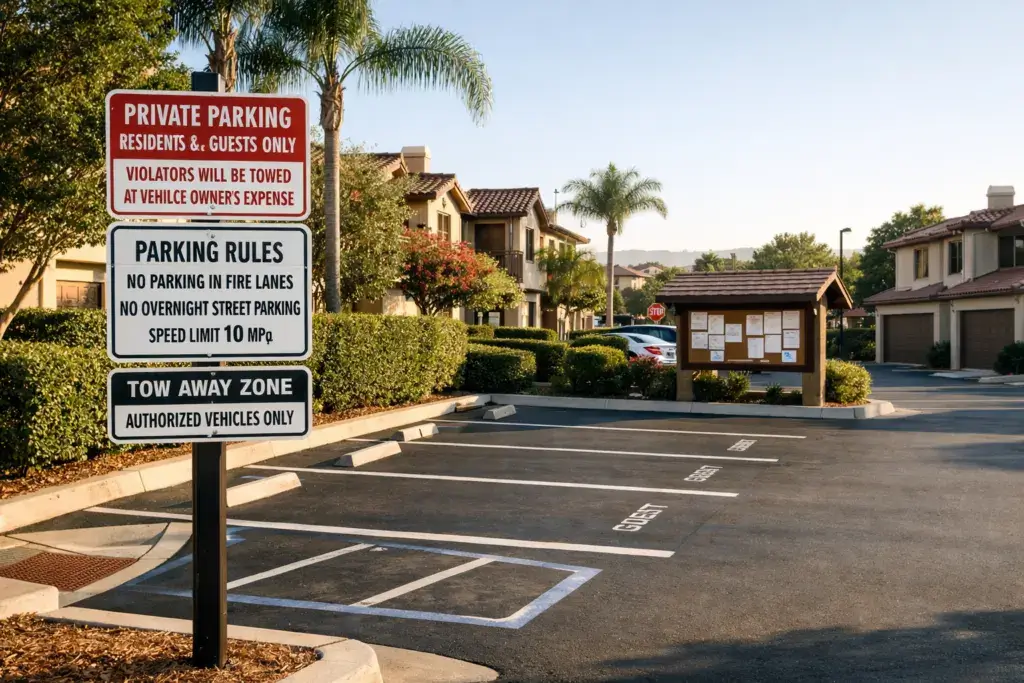
Towing without proper notice procedures is another legal exposure area.
California Civil Code §22658 governs private property towing requirements.
External Reference:
California Civil Code §22658
Improper signage, lack of posted rules, or failure to follow notification procedures can result in:
- Financial penalties
- Resident litigation
- Reimbursement claims
Clear documentation and structured enforcement policies significantly reduce this risk.
How Technology Reduces Legal Risk
Technology alone does not eliminate liability — but it creates structure.
Modern parking systems help communities:
- Document rule acknowledgment
- Centralize permit records
- Log enforcement activity in real time
- Provide timestamped violation records
- Maintain transparent audit trails
Interactive mapping tools also reduce ambiguity by clearly defining:
- Assigned spaces
- Guest spaces
- Reserved or premium areas
Learn More About Interactive Space Management
Clear visibility reduces disputes before they escalate into legal conflicts.
Revenue Strategies Must Be Structurally Designed
Charging for long-term or short-term parking spaces can be valuable — but only when:
- Authorized by governing documents
- Approved appropriately
- Structured transparently
- Clearly communicated to residents
Parking monetization is a strategy — not a shortcut.
Communities that align:
Legal authority
Operational clarity
Transparent enforcement
Data-backed documentation
Reduce both liability and resident friction.
Parking Is Operational — But Also Legal
The biggest mistake boards make is treating parking purely as an operational issue.
Parking touches:
- Governance
- Fiduciary responsibility
- Financial management
- Resident rights
- Compliance obligations
Poorly written rules increase liability.
Well-structured systems reduce it.
Next Steps: Review Before You Revise
If your HOA or apartment community is:
- Considering new parking fees
- Updating enforcement procedures
- Exploring short-term or long-term space rentals
- Changing towing policies
It’s critical to evaluate both operational efficiency and legal authority.
If you’re already partnered with Reliant Parking, schedule a compliance strategy review with your Account Manager to evaluate rule structure and documentation workflows.
If you’re evaluating a new parking management system, book a demo for a consultation on how structured, documented enforcement can reduce legal exposure.
Book a Demo
https://www.reliantparking.com/contact/
Beyond software.
Your Parking Partner.